
Photovoltaic Cover Glass
Uniform textures for solar module glass manufacturing.
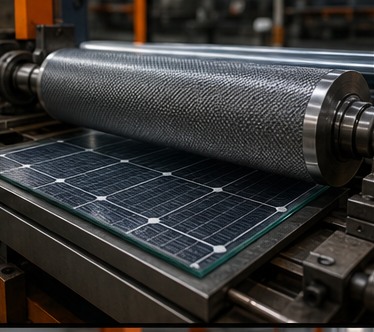
Solar glass embossing rollers form controlled surface textures that influence light transmission, diffusion and appearance. Pattern uniformity across wide glass production lines is critical.
Request Technical Discussion +Solar glass embossing rollers form controlled surface textures that influence light transmission, diffusion and appearance. Pattern uniformity across wide glass production lines is critical.
Each application has different material behavior, operating conditions and surface expectations. The roller specification is developed accordingly.
Uniform textures for solar module glass manufacturing.
Engineered patterns that manage glare and optical distribution.
Repeatable functional surfaces for energy and industrial applications.
Stable pattern geometry supports repeatable light behavior across glass sheets.
Face profile and engraving consistency are controlled over the full working width.
Material and finish are selected for demanding glass-line conditions.
Approved texture references and repeat data support future replacement requirements.
Final dimensions and materials are confirmed against the approved drawing and operating data.
| Primary product | Patterned photovoltaic and technical glass |
|---|---|
| Design inputs | Glass width, temperature, line speed, pattern geometry and optical target |
| Critical controls | Face profile, repeat, engraving depth and thermal stability |
| Roll construction | Application-engineered steel body and shaft arrangement |
| Inspection | Pattern geometry, width consistency, dimensions and surface condition |
We review the material, machine arrangement and performance target for this roller.
Roll geometry, surface specification and process parameters are defined for solar glass embossing rollers.
Machining, engraving or polishing is completed under dimensional process control.
The finished roller is checked, protected and prepared for domestic or export delivery.
Variation can affect appearance and optical performance across the panel area.
A measurable roller, glass sample or approved technical drawing can be used for evaluation.
Glass width, operating temperature, line speed, desired pattern and machine mounting data are essential.
Share the material, working width, roller drawing and desired surface result for a technical review.