
Architectural Glass
Patterns for doors, partitions, facades and interior glazing.
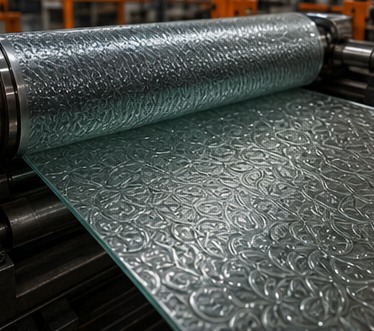
Glass embossing rollers create architectural, privacy and decorative patterns while the glass is in a formable state. The engraving must remain uniform under heat and continuous production loads.
Request Technical Discussion +Glass embossing rollers create architectural, privacy and decorative patterns while the glass is in a formable state. The engraving must remain uniform under heat and continuous production loads.
Each application has different material behavior, operating conditions and surface expectations. The roller specification is developed accordingly.
Patterns for doors, partitions, facades and interior glazing.
Light-transmitting textures that reduce direct visibility.
Geometric, organic and custom designs for furniture and interior products.
Engraving geometry is developed for molten or softened glass response.
Roll material and dimensions account for operating temperature and expansion.
Decorative, privacy and functional patterns can be developed from references.
Geometry, journals and balance are checked for continuous line duty.
Final dimensions and materials are confirmed against the approved drawing and operating data.
| Glass products | Architectural, decorative, privacy and patterned glass |
|---|---|
| Design inputs | Glass thickness, width, temperature, speed and pattern target |
| Pattern options | Geometric, organic, textured and custom artwork |
| Engineering controls | Thermal behavior, face profile, repeat and journal arrangement |
| Inspection | Dimensions, runout, pattern depth, repeat and face consistency |
We review the material, machine arrangement and performance target for this roller.
Roll geometry, surface specification and process parameters are defined for glass embossing rollers.
Machining, engraving or polishing is completed under dimensional process control.
The finished roller is checked, protected and prepared for domestic or export delivery.
Yes, from suitable artwork, a physical sample or a technical pattern reference.
Yes. Material choice, expansion, geometry and cooling conditions must be considered.
Engraving depth, repeat dimensions and face-to-face uniformity are inspected before dispatch.
Share the material, working width, roller drawing and desired surface result for a technical review.